


31 Mar Haircare Social Media Benchmarks: What 12 Brands Reveal About Followers, Engagement, and What Actually Drives Sales
Research Report · March 2026
8 min read
We analyzed 12 brands across Instagram, TikTok, and influencer marketing from February 2025 through January 2026. The data reveals a widening gap between follower counts and real engagement — and points to the strategies that are actually moving product.
If you manage social media for a haircare brand, there’s a number worth paying close attention to, and it’s probably not the one on your follower count.
Our new Snap Analysis of the haircare category examines 12 brands across Instagram, TikTok, and influencer marketing over a full year. We segmented those brands into three tiers — Legacy (Aveda, Wella, Carol’s Daughter, Innersense), Disruptors (K18 Hair, Pattern Beauty, Kitsch, oVertone), and Emerging (The Doux, Amika, DpHue, Ouai) — and the performance gaps between them tell a clear story about what’s actually working in this category right now.
This is the second installment of our Snap Report series, following our salty snacks social media analysis. If anything, the haircare data is even more dramatic.
Instagram: The Ghost Following Crisis Hits Haircare Hard
The biggest follower count in this study belongs to Ouai, at nearly 3 million. Impressive, right? Now look at the engagement rate: 0.27%. That is the lowest in the entire competitive set. Wella isn’t much better — 1.47 million followers and a 0.46% engagement rate, despite cranking out 577 posts across the study period (the highest volume of any brand we tracked).
We call this the “Ghost Following” problem: large audiences accumulated during Instagram’s early growth years that have gone cold. They don’t like, they don’t comment, and they aren’t converting to customers. It’s a pattern we see across CPG categories, and it creates a real structural challenge. Those inflated numbers can suppress organic reach and make it harder to get an accurate read on what’s actually working.
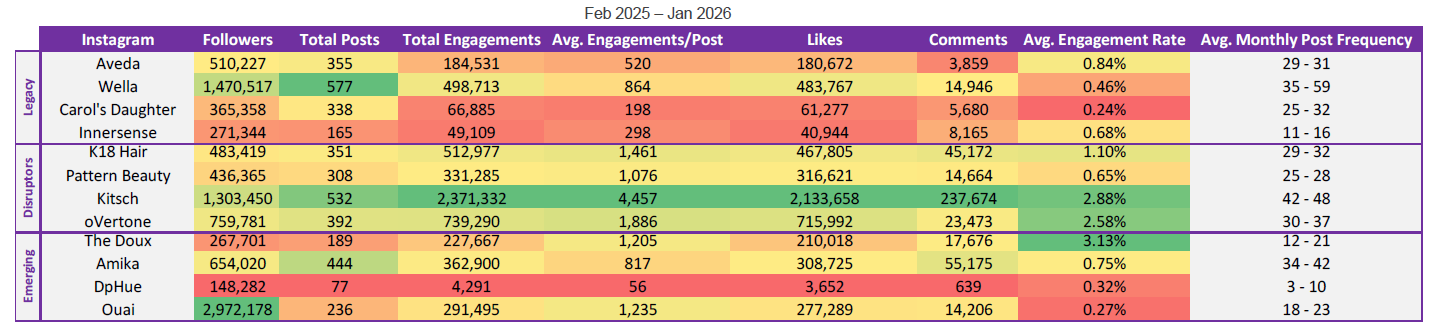
Now look at the other end of the spectrum. The Doux leads the entire study with a 3.13% Instagram engagement rate on just 189 posts. They are doing more with less in a way that’s worth studying closely. Kitsch is the study’s absolute powerhouse, generating 2.37 million total engagements with a 2.88% engagement rate; dominating every absolute metric while also maintaining efficiency. And oVertone quietly posted a strong 2.58% rate, proving that a focused color-category brand can punch well above its weight.
Meanwhile, Carol’s Daughter (despite 365,000 followers) averaged just 198 engagements per post with a 0.24% rate. DpHue managed only 56 engagements per post across 77 posts, suggesting an audience that hasn’t yet been activated through the kind of content that drives interaction.
Because we used publicly available data, we calculated engagement rate as (Likes + Comments) / Follower Count × 1,000. This is non-traditional but makes apples-to-apples comparison easier to interpret at a glance.
The Content Quality Gap: Intent Beats Aesthetics
The format story is straightforward: Reels are the dominant engagement driver across the competitive set. The Doux’s Reels generate 66% higher engagement than their Carousels, making video the unambiguous engine of their strategy. Kitsch, interestingly, gets nearly identical engagement across all three formats, suggesting their advantage is content quality and posting cadence, not format dependence.
But the more telling divide isn’t format, it’s intent.
K18 Hair runs a video-first strategy like most of its competitors, but what separates them is how they use it. Every format — Reels most of all — functions as an educational vehicle. By prioritizing what I’d call “informational density” and science-forward messaging over lifestyle aesthetics, K18 maintains an overall engagement rate that outperforms every Legacy brand in the study, despite competing in the same follower range.
Then there’s what we call the “Conversion Delta:” the qualitative gap between brands that generate pre-purchase dialogue in their comments and those that generate passive reactions (or nothing at all). The Doux is the clearest example: their product launch posts around the Block Party collection generated 971 to 2,805 comments on content that wasn’t incentivized. That’s the kind of comment section that connects directly to shelf velocity.
Contrast that with Wella and Carol’s Daughter, where multiple posts registered zero comments despite massive follower counts. The content is being published; the community just isn’t responding. That’s a data point worth investigating, because it usually signals a disconnect between the content strategy and the audience that’s actually following the brand.
TikTok: Where Legacy Scale Meets Emerging Resonance
TikTok is where the tension between reach and resonance becomes most visible in this dataset.
Wella is the undisputed reach powerhouse, generating 108 million total views across the study period. That number dwarfs every other brand — K18 Hair and Kitsch, the next closest, both landed around 18–24 million views. But Wella’s 1.46% engagement rate tells a different story. The view count relative to their follower base and total posts strongly suggests a meaningful investment in paid TikTok distribution, which tends to inflate views while suppressing engagement rate. This is a broadcast strategy more than a community strategy — effective for sustaining visibility, but with room to grow on the engagement side.
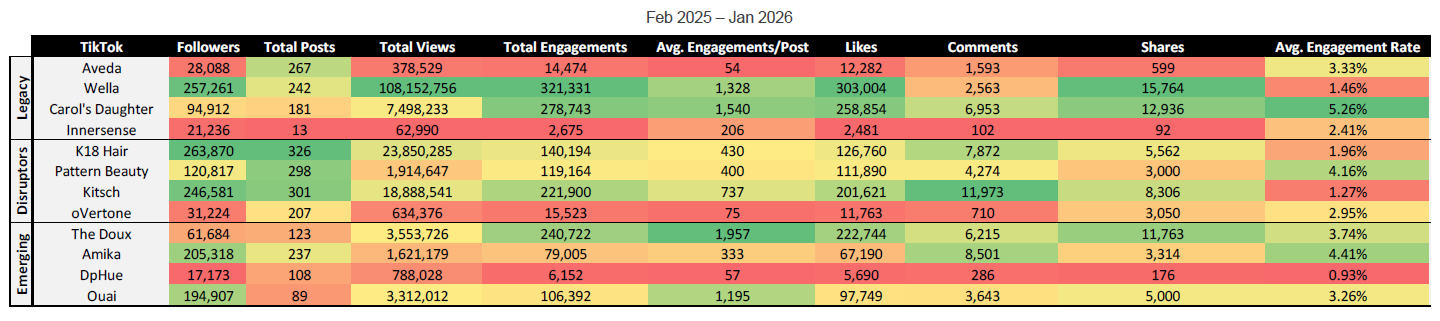
The resonance leaders are a more interesting group. Carol’s Daughter is the surprise performer with a study-leading 5.26% TikTok engagement rate, driven largely by founder Lisa Price’s storytelling — proof that authentic, personality-driven content translates directly to platform efficiency. Amika posts at a consistent 17–21 times per month and maintains a 4.41% rate — genuine volume without sacrificing resonance. Pattern Beauty leverages Tracee Ellis Ross as a founder anchor to reach 4.16%, and The Doux continues its strong performance with a 3.74% rate built on educational product content.
All four demonstrate the same underlying principle: audience alignment outperforms audience size.
The Algorithm Risk You Can’t Ignore
Here’s a cautionary tale. Innersense posted just 13 times on TikTok across the entire year — roughly once a month. When they did post, their content performed well, achieving a 2.41% engagement rate that outperformed most of the Disruptor category. But the TikTok algorithm rewards consistent posting signals. Without regular content to train the algorithm, even strong individual posts fail to reach the audiences they deserve. Innersense has good content and a real audience — they’re just not showing up often enough for the algorithm to consistently reward them.
On the other end, brands like Utz in our salty snacks analysis showed that high-volume posting with low engagement is equally dangerous. TikTok reduces distribution for accounts that consistently post low-performing content. The sweet spot is consistent posting at a cadence your content quality can sustain.
Influencer Marketing: Haircare Brands Are Getting Mentioned at a Staggering Rate
This is where the data gets genuinely consequential for brand marketers — and where the haircare category separates itself from almost every other CPG vertical we’ve studied.
We track influencer mentions across a global database of 23 million monitored creator accounts, covering both paid and organic content. For context: in our salty snacks report, the most-mentioned brand was Doritos with 9,240 mentions across an entire year. Wella beat that number in a single month, generating 12,140 influencer mentions in just the last 30 days of our study period. K18 Hair followed at 9,320. Kitsch logged 7,350. Amika posted 5,800.

That volume is extraordinary by any CPG standard, and it tells us something important about the haircare category specifically: creators talk about hair products at a frequency that dwarfs most other consumer categories. The tutorial-friendly, results-visible nature of haircare makes it uniquely suited to influencer-generated content.
Why does this matter for your bottom line? Research shows that influencer-generated content can drive a 3% to 18% increase in incremental in-store sales for CPG brands. For brands like Wella and K18, those high mention volumes serve as a protective moat — a level of third-party validation that smaller competitors simply can’t replicate overnight.
At the other end of the spectrum, DpHue registered 166 influencer mentions in the same 30-day window, and oVertone had 419. For brands in this category, understanding where you fall on that spectrum — and whether the gap is growing or shrinking — is worth tracking alongside your owned-channel metrics.
What This Means for Your Haircare Social Media Strategy
Whether you’re managing social strategy for a legacy haircare brand or a fast-growing disruptor, this data points to a few conclusions that are hard to argue with:
Key Takeaways for Haircare Brand Social Media Marketing
- Audit your engagement rate honestly. A large follower count paired with a sub-1% engagement rate deserves a closer look. Across this study, several brands with impressive followings showed engagement rates below 0.5% — a pattern we call a Ghost Following. It’s worth understanding whether your audience is genuinely engaged or largely inherited from an earlier era of the platform.
- Educational content outperforms lifestyle aesthetics. K18 Hair’s science-forward, informational-density approach outperforms every Legacy brand in the study — on a platform that was supposedly built for pretty pictures. The data suggests that teaching your audience something consistently drives stronger engagement than polished product imagery alone.
- Measure the Conversion Delta, not just engagement. Count the comments asking about product availability, ingredients, or purchase intent. The Doux generates thousands of organic, non-incentivized comments on product launches. That’s worth more than a million passive likes.
- On TikTok, consistency matters as much as quality. Innersense proves you can have strong content and still fail to build momentum if you post once a month. The algorithm needs regular signals. Find a sustainable posting cadence — Amika’s 17–21 posts per month with a 4.41% engagement rate is a solid model.
- Founder-led content is a cheat code. Carol’s Daughter with Lisa Price and Pattern Beauty with Tracee Ellis Ross both demonstrate that authentic founder presence drives measurably higher TikTok engagement. If your brand has a visible founder or formulator, put them on camera.
- Invest in influencer marketing with a retail lens. Haircare brands generate influencer mentions at a rate that dwarfs most CPG categories. The gap between brands with 9,000+ monthly mentions and those with a few hundred is significant — and it tends to correlate with retail performance. With a proven 3–18% lift in in-store sales, influencer-generated content isn’t just brand awareness — it’s a performance channel worth indexing against your competitors.
The Bottom Line
The haircare category is a sharper version of the same story we told in our salty snacks analysis: disruptors and emerging brands are winning not because they have bigger budgets, but because they have better content strategies. Kitsch doesn’t have the biggest following — they have the most engaged one. The Doux posts less than almost every brand in the study and generates more meaningful engagement than brands posting three times as often. K18 built a content strategy around education, not aesthetics, and it outperforms every legacy competitor.
Legacy brands aren’t doomed — far from it. Carol’s Daughter’s TikTok performance proves that a legacy brand can absolutely compete on resonance when it leans into storytelling and platform-native content. The opportunity is there. But the data makes it clear that a large Instagram following built years ago isn’t doing the heavy lifting it once did.
The brands winning in hair care social media marketing in 2026 will be the ones that stop optimizing for reach and start optimizing for resonance. If you want to see how your brand stacks up — or dig deeper into what the top performers are doing that your brand could adopt — we’re happy to pull a custom competitive analysis.
This analysis is based on publicly available data collected from February 2025 through January 2026.